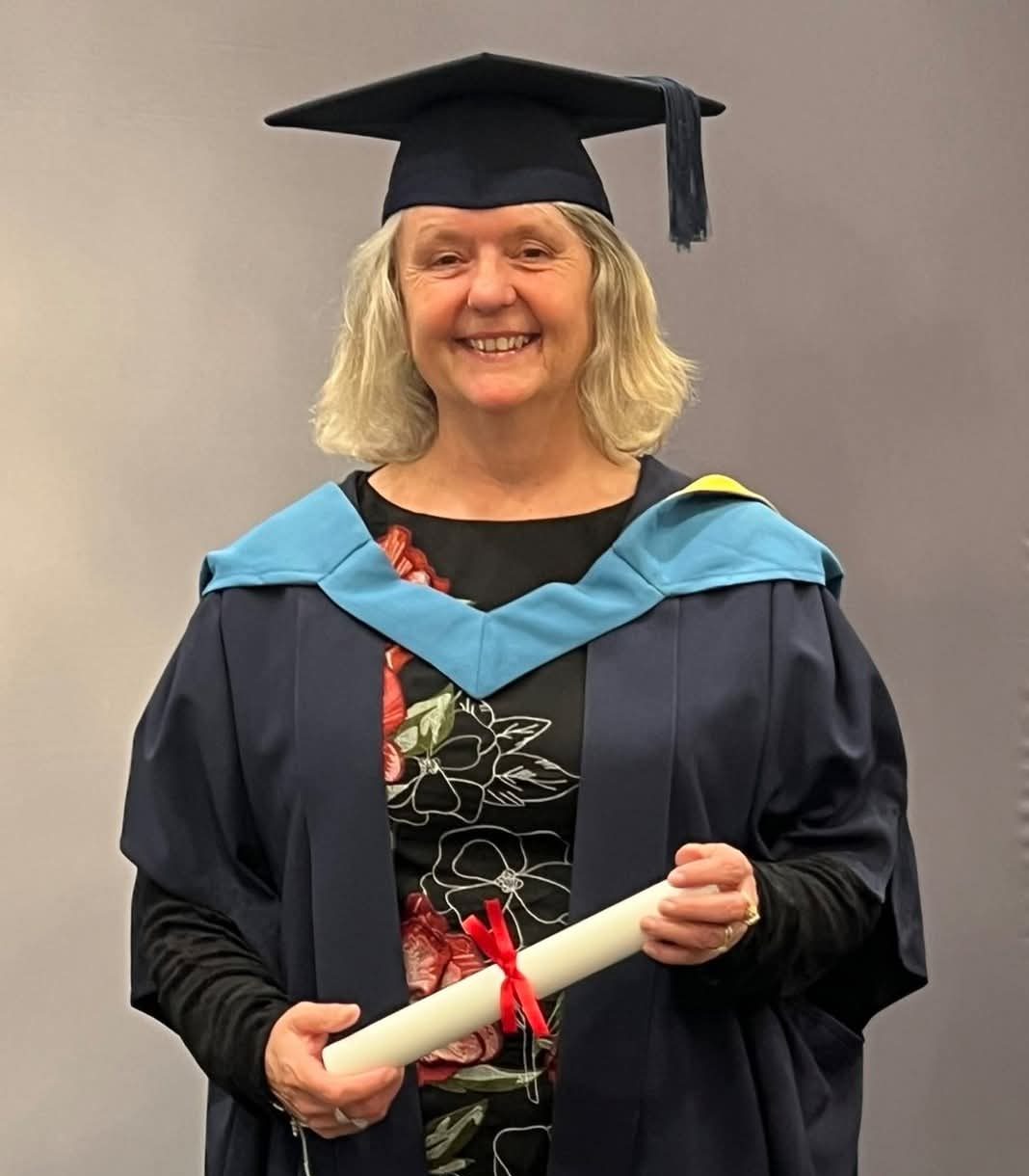
Patient and Public Involvement and Engagement (PPIE) plays a vital role in shaping research that is meaningful, relevant, and grounded in real-world experience. By ensuring that the voices of patients, carers, and communities are heard from the very beginning, PPIE helps guide research questions, improve study design, and enhance the impact of findings.
It also offers an empowering pathway for individuals to become more deeply involved in the research process, building confidence, skills, and a sense of belonging within academic and clinical environments. For many, PPIE becomes far more than a contribution to a single project; it can serve as a stepping stone toward new opportunities, including education and careers in research.
In the following interview, PPIE contributor Heather Boult shares her journey and reflects on how these experiences inspired and supported her during her degree.
- Congratulations on graduating! How did it feel to complete your degree after six years of part-time study?
Relieved, delighted, excited for a new chapter of interest, and to have recognition of my commitment and time. I also felt a bit of loss – weekends and nights are now free from TMAs!
- You mentioned being inspired by many PPIE members and researchers. What role has your involvement in PPIE played in motivating or supporting you during your studies?
Seeing how a patient voice can contribute to a study or topic, change the way physical or mental health is addressed, and include all people regardless of age, ethnicity, or barriers they face. Bringing real-world experience to the topics researchers were studying and watching their dedication and time devotion, from an initial idea through to 2–5 years of completion, was totally inspiring. To see the real difference when patients in hospitals experience research inspired me.
The many PenPEG, PPIE members, and the PenARC teams said, “You can do it, go study what interests you. Just do it, go for it, you can do it!” They all supported me when my motivation was challenged, through illness, difficult times, or competing work and meeting demands. Being students, researchers, or friends who had experienced studying too, they supported me with motivation, words, kindness, flexibility, or just keeping me in the loop by email, adapting and being genuinely interested in my progress.
- Looking back to when you first got involved in PPIE work, what drew you to it, and how has your involvement evolved?
I first got involved with nurses, doctors, trainee doctors, and clinicians in three different hospitals my two children were attending over a 0 – 27-year period. I observed that many children’s voices were not being heard, listened to, or even addressed in their long-term health care, even though it was their bodies having surgery, treatments, and biopsies. Their voices were overlooked and not considered important, even at age 14, when they had questions about school, leisure, friends, medication changes, and how long they would be unable to participate in everyday life.
I saw a university stand at the Devon County Show, which spoke to my children about careers, courses, diabetes, and health in general. I quickly got into a conversation and signed up for the Exeter 10,000 study, which I’m still part of now. The person there contacted me about a meeting to hear the voice of carers with children with long-term conditions and convinced me to join the new group, PenPEG, now PenARC at Exeter Medical School and the University.
This motivated me to attend a university PPIE meeting. Having never set foot in a university before, I was surprised by their warm welcome and quickly felt I could voice my views productively. Fifteen years later, from that initial meeting, I have attended many more meetings and events on health-related topics, INVOLVE presentations, and gained valuable experience in larger and more complex meetings with clinicians, academics, and other PPIE members.
Motivated by this work, I now take an active part in clinical trials, undergraduate nurse and doctor training, interviewing graduates for positions, supporting students with my PPIE experience, and helping DClinPsy mental health candidates. I have sat on NHS dental and NICE pelvic floor dysfunction guideline groups, and this year I sat on NIHR Health and Social Care and Mental Health committees, providing a PPIE voice on funding for 5-year projects. For the last four years I have also been a PPIE lay examiner for the RCOG, which I find very rewarding. I’ve taken part in researchers’ ideas cafés and biomedical research cafés, hearing proposals and giving PPIE support to early-career researchers. I’m also part of other projects at Bristol and London, with confidential elements removed as requested.
- You’ve just started a new job and recently acted as a lay examiner for the RCOG. How has your experience in PPIE contributed to your confidence, skills, or opportunities in these roles?
My experience as a mum, carer, and patient experiencing medical concerns, pre-pregnancy, as a mother, and post-menopause, combined with my work with children, young people, mums, and the wider community, helped shape my PPIE involvement in child health and maternity, including mental health, domestic violence, CBT, and toothbrushing projects. Being part of the NICE pelvic floor dysfunction guidelines propelled my interest in becoming a PPIE lay examiner for the Royal College of Obstetricians and Gynaecologists. Bringing my knowledge and experience, I contribute ideas for new questions to test RCOG candidates in real-life scenarios.
My experience as a PPIE contributor, combined with my six-year degree in social sciences and psychology, gives me the confidence and knowledge to take part in many roles and opportunities and to ask the questions the general public wants answered or addressed.
My new job is as a receptionist at the Met Office. I’m interested in health, the environment, and climate change. While my actual role does not cover this, my PPIE contributions inspire my understanding of their work and its impact on people. One day, I hope to get a longer contract for paid PPIE work with Exeter University to improve patient outcomes.
- What has been the most rewarding part of being a PPIE member for you personally?
The most rewarding part, genuinely, is when a researcher says “thank you.” Hearing feedback about the difference you made to their proposal, idea, or outcome through your suggestions or contributions gives value to your time as PPIE and motivates you to continue.
- Can you share any memorable moments or interactions from your PPIE journey that have stayed with you or shaped your perspective?
In 2011/2012, I took part in the NHS dental guidelines for young children with additional needs in London. It was the first time I attended an important meeting where clinicians, academics, and PPIE worked together. As I sat in a horseshoe-shaped meeting room, I stood up and said: “This is not the case for children in hospital! This is what actually happens… You need to listen to their views and their parents when they ask questions!” I left the room speechless. I was shaking with emotion but they applauded me. A very senior clinician said, “This is why we need PPIE. We need to hear the voices that are not being heard.”
Those words have never left me, especially when they asked me to join the specialist dental group for the next three years. Seeing your ideas come into print, as with NICE guidelines, reflects our PPIE input, and this has inspired me many times when I’ve wondered what difference I can make just by being there.
- For others considering getting involved in PPIE, what would you say to them?
Do it, do it, do it! Don’t delay, speak up today. Give your voice to others who cannot speak. Sign up to Be Part of Research, look on VOICEs, speak up in your community. Be the voice that questions things. Ask your GP, pharmacist, university, or charity about patient involvement groups. Be part of clinical trials, volunteer at medical clinics.
Instead of dwelling on a poor experience, turn it around and think: “What do I want to see happen? How can I improve this? Who can I talk to?” If you can see a gap or barrier that needs speaking up about, share your ideas. It’s much easier now with online sources to get involved, but we need more visibility outside universities – PPIE in supermarket noticeboards, libraries, banks, bus shelters, TV, radio, for example.