
On 3rd October 2025, PenARC co-hosted a powerful and thought-provoking online event, Co-Creating Change: Designing Domestic Abuse Services Together, in collaboration with ARC North East and North Cumbria, and King’s College London.
The event brought together a diverse group of health and social care professionals, commissioners, policy makers, community service and VCSO representatives, domestic abuse and Family Hub staff, and – most importantly – people with lived experience of domestic abuse.
It built on the success of the RIVA study, a PenARC-supported project evaluating models of Maternity Violence Advisor provision within maternity services.
Lived Experience in Action
At the heart of the event was a vital question: How can we meaningfully involve people with lived experience in the design of domestic abuse services?
Throughout the day, we were reminded that when the voices of people with lived experience of domestic abuse shape the services intended to support them, outcomes improve – not just for individuals, but for systems as a whole.
Highlights included:
- The launch of a short, animated video, co-created with people with lived experience and practitioners who support them, offering guidance on best practices for meaningful involvement. You can watch the video on this webpage.
- A training session, developed by people with lived experience, demonstrating what trauma-informed, authentic engagement can look like.
- A rich panel discussion featuring perspectives from research, frontline practice, policy, and lived experience.
- Reflective and interactive spaces for attendees to share ideas, ask questions, and connect around shared challenges.
Peer Researcher on the project Vita Moltedo said:
“As a Peer Researcher on the project, it was truly significant to be asked to be one of the speakers at the RIVA Study event – the Researcher’s willingness to share the ‘podium’ showed that public contributors can be involved at every stage of a project in a truly meaningful way and that their contribution is valid and valuable. ‘Giving people a voice’ does not have to be just a figure of speech”.
Key Messages from Our Speakers
We were honoured to hear from a panel of experts with diverse perspectives and a shared commitment to change.
Dr Sandi Dheensa, University of Bristol
Dr Dheensa highlighted the often-overlooked reality that healthcare professionals themselves can experience domestic abuse. She called attention to the lack of confidential NHS support for staff and emphasised the need to avoid “us vs. them” language in training and policy.
📚 Read Dr Dheensa’s review on healthcare professionals experiencing domestic abuse.
Jessica Privilege, Domestic Abuse Commissioner’s Office
Jessica underscored the pivotal role of health services in recognising and responding to domestic abuse. She outlined the role of the Domestic Abuse Commissioner’s Office and current priorities, including all policy work being rooted in lived experience. Jessica spotlighted the Domestic Abuse Act 2021, which recognises children as victims in their own right – a milestone that must shape future service design.
📘 Read the Domestic Abuse Commissioner’s report: “Victims in their own right?”
Jackie Gilbank, Domestic Abuse Commissioner’s Office
Jackie stressed that engagement with lived experience must be values-driven, not a tick-box exercise. She urged attendees to consider whose voices are missing, and how to create inclusive spaces that allow all experiences to be heard.
“Lived experience matters. If you are designing services without the people who use them, you are going to miss the mark.” – Jackie Gilbank
Nikki Kelly, SafeLives
Nikki advocated for a whole-system, public health approach to ending domestic abuse – placing survivor voices at the centre of everything from local to national service design. She shared insights from projects, such as work with Hampshire County Council to put local organisations and people with lived experience at the heart of tackling domestic abuse by supporting them to share lived experience and develop best practice.
📘 Read about SafeLives’ public health approach
“Anyone can experience domestic abuse. Our experience is affected by our identities.” – Nikki Kelly
Creative and Collaborative Highlights
One of the day’s standout resources was a short, animated video, developed through focus groups with practitioners working with people affected by domestic abuse and interviews with people who have experienced domestic abuse, providing a practical, accessible tool for professionals across the sector.
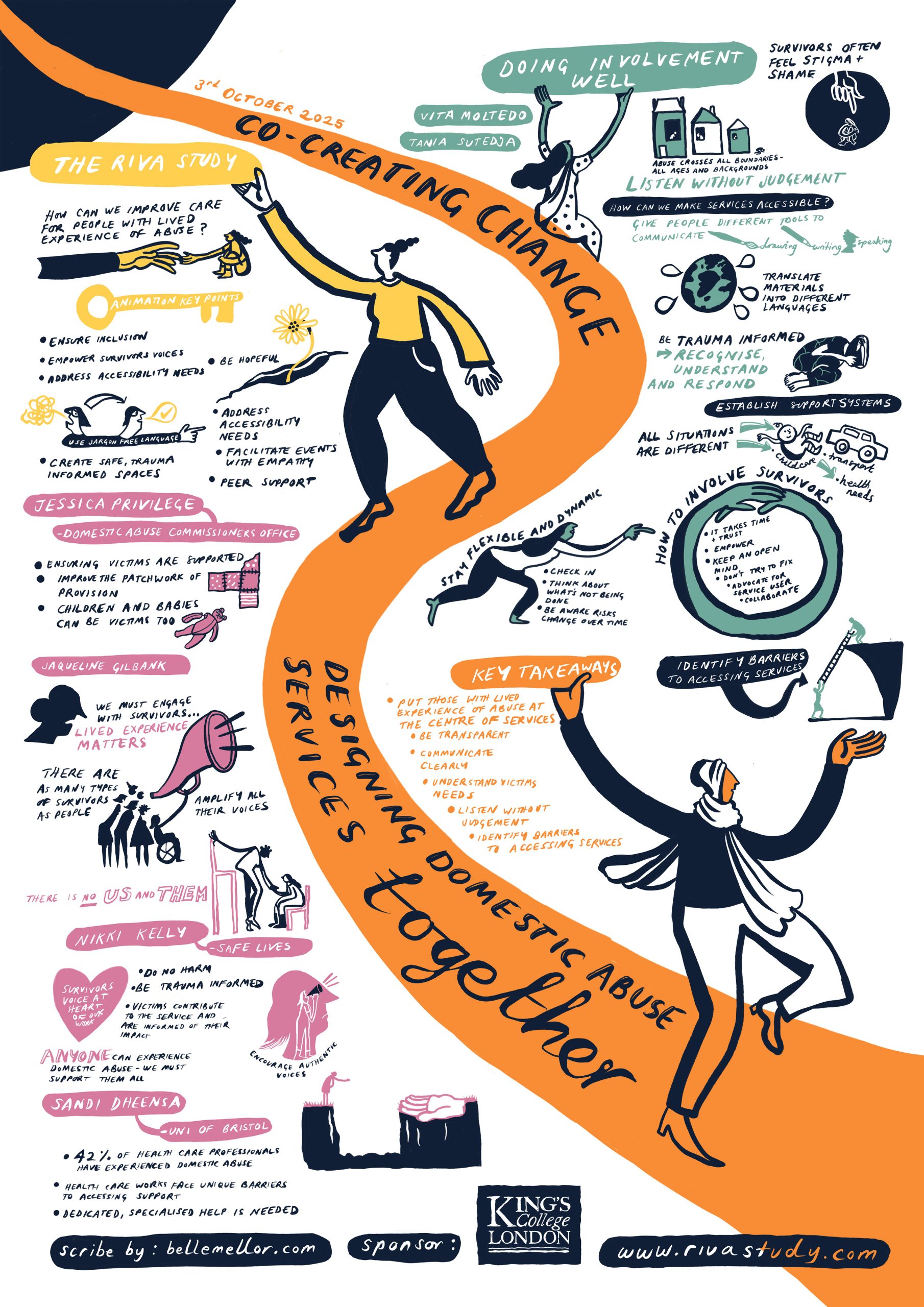
We were also joined by live illustrator Belle Mellor, who captured the day’s key themes in real-time. Her artwork brought to life what service design can and should look like.
Real Reflections, Real Learning
Attendees contributed rich insights and honest reflections, including:
- How to support quieter voices in group settings.
- Adapting language and engagement tools for young people.
- Providing flexible engagement options for those with unpredictable lives.
- The importance of post-separation abuse and coercive control training.
- Ensuring disabled people with lived experience can participate meaningfully.
- Partnering with specialist organisations to reach underrepresented groups.
- Creating pathways to paid roles for people with lived experience.
Practical suggestions also emerged, such as offering 1:1 conversations before or after sessions, providing multiple ways to engage, and regularly checking in to ensure processes remain supportive and empowering.
Looking Ahead
Co-Creating Change was more than an event – it was a commitment to doing better.
To truly embed lived experience in the design of domestic abuse services, we must move beyond tokenism and build services that are safer, more responsive, and more just.
We are deeply grateful to all the speakers, facilitators, contributors, and attendees who brought openness, honesty, and insight. Your voices are shaping services that reflect the realities – and rights – of those they exist to support.
Watch a recording of the Co-Creating Change: Designing Domestic Abuse Services Together event here.